

Flying with a surfboard in 2026 requires more planning than ever. Airline baggage policies continue to shift; fees are increasingly route- and fare-dependent, and surfboards remain one of the most misunderstood items at airport check-in counters.
This 2026 Surfboard Baggage Fee Guide is built to remove uncertainty. We’ve compiled verified surfboard policies from major U.S. airlines, explained how airlines classify boards, highlighted common mistakes surfers make at the airport, and shared proven strategies to reduce both baggage fees and board damage. For surfers who travel often, pairing this knowledge with durable, purpose-built gear from trusted brands like FARO Board Bags can make a significant difference in both cost control and board protection.
Every airline policy referenced below is sourced directly from official airline websites, so you can plan your trip with confidence - not guesswork.
Why Surfboard Fees Are Increasing
Airlines increasingly rely on ancillary revenue - fees charged beyond the base ticket price. Oversized and specialty baggage is one of the fastest-growing revenue categories, and surfboards often fall into this gray area.
Even when airlines claim to be “surf-friendly,” unclear rules around size, weight, and packing can result in unexpected charges at the counter. In many cases, a $250 ticket becomes a $500 trip once surfboard fees are added.
Understanding policies before booking allows you to:
- Choose airlines that align with your board size
- Avoid overweight and oversize penalties
- Decide whether flying with boards actually makes financial sense
Below is a breakdown of how major U.S. airlines handle surfboards in 2026, with fees verified directly from official airline sources.

U.S. Airlines Surfboard Baggage Fees
Alaska Airlines & Hawaiian Airlines
In late 2025, Alaska Airlines and Hawaiian Airlines announced one of the most generous surfboard policies among U.S. premium carriers following their merger. Surfboards are now treated as standard checked baggage with no special item fees.
Domestic & International Flights: Standard checked bag fee applies ($35 for the first bag)
Key Benefits:
- One surfboard or paddleboard case is treated as one checked item
- Up to 2 boards allowed in a single bag
- Maximum weight: 50 lbs (overweight fees apply above this limit)
- Maximum length on Boeing 737 & Airbus aircraft: 125 inches (10 ft 5 in)
- For Alaska Airlines flights 2000–3499 (regional aircraft):
- Maximum combined dimensions: 115 inches
- Practical length limit: 9 ft 7 in
- No oversize fees when within stated limits
Important: Surfboards or paddleboards exceeding 50 lbs will incur standard overweight baggage fees.
Why Choose Alaska/Hawaiian: Generous size limits, allowance for multiple boards per bag, and no extra surfboard fees make them among the best airlines in the U.S. for surf travel. Alaska credit cardholders and Mileage Plan members may also receive free checked bag benefits, further reducing costs.
American Airlines
American Airlines has streamlined its surfboard policy to make it easier for travelers flying with boards. Surfboards are generally treated as standard checked baggage when they meet weight and size requirements, avoiding specialty equipment surcharges.
Domestic Flights: Standard checked bag fee applies ($35–$40 for the first bag, depending on booking method)
International Flights: First checked bag is often included, depending on destination and fare class
Key Specifications:
- 1 surfboard bag or case counts as 1 checked item, even if it contains multiple boards
- Keels, edges, and/or fins must be removed or properly protected
- Maximum weight: 50 lbs / 23 kg
- Over 50 lbs (up to 70 lbs / 32 kg): Standard overweight fee applies for travel on or after April 17, 2024
- For travel on or before April 16, 2024: $150 overweight fee applies from 51–70 lbs
- Oversize fees do not apply
Why Choose American: No oversize charges for surfboards and the ability to pack multiple boards in one bag make American a solid option. Its extensive domestic and international network provides broad access to major surf destinations.
Delta Air Lines
Delta allows surfboards to be checked as special items without a dedicated surfboard fee on most routes. When boards meet size and weight limits, only standard checked baggage charges typically apply.
Domestic Flights: Standard checked bag fee applies ($35 for the first checked bag)
International Flights: Standard baggage allowance and fees apply based on travel region and cabin
Key Specifications:
- Up to 2 surfboards allowed per bag
- Maximum weight: 50 lbs
- Over 50 lbs: Applicable excess weight fees apply
- Maximum linear dimensions: 115 inches (length + width + height)
- Surfboards exceeding 115 linear inches are not accepted
- Items exceeding baggage allowance are subject to additional fees
Important Note: Surfboard acceptance on Delta Connection flights may vary. Surfboards over 72 inches in length are not permitted on Delta Connection carrier flights. Travelers should contact Delta Reservations to confirm aircraft compatibility.
Why Choose Delta: Clear size limits and no surfboard-specific fees make Delta a reliable option for surfers flying on mainline aircraft.
Frontier Airlines
Frontier Airlines offers low base fares, but it's a-la-carte pricing model means surfers must carefully calculate baggage costs. Surfboards are accepted, yet multiple layered fees can significantly increase the total cost of travel.
Domestic Flights: Checked bag pricing is based on the fare option purchased; overweight and oversize charges apply if applicable
Key Specifications:
- One item includes one surfboard, wave ski, or kite board
- Skeg fin must be encased in protective material
- Checked baggage only (carry-on not permitted)
- Maximum weight:9 lbs (items exceeding this are not accepted)
- Maximum length: 15 feet (items exceeding this are not accepted)
- Overweight and oversize baggage charges apply when applicable
- Passengers should allow an extra 30 minutes for check-in
Important: Except where required under the Montreal Convention, Frontier does not accept liability for damage or loss of surfboards unless they are packed in a hard-sided case.
Why Consider Frontier: Accepts very long surfboards, making it an option for longboard travelers on select routes.
Considerations: Fare-based baggage pricing combined with overweight and oversize charges can significantly increase total travel costs.
JetBlue
JetBlue has updated its surfboard policy to be more board-friendly, especially for smaller boards like shortboards and funboards. While fees are standard, the lack of oversized charges makes it an attractive option for surfers traveling with smaller boards.
Domestic & International Flights: $100 flat fee per surfboard
Key Specifications:
- Maximum weight: 100 lbs (overweight fee: $150 for bags over 50 lbs)
- One surfboard per case (strictly enforced)
- Surfboard must be packed in a proper surfboard case
- JetBlue recommends hard-sided cases to prevent damage
- Surfboards are NOT accepted on flights to/from Bermuda, Haiti, Peru, Port of Spain, Santo Domingo, and Santiago
- Surfboards are accepted to Puerto Plata and Punta Cana, Dominican Republic
Important: Surfboards must be packed properly to avoid damage to the board or other checked luggage.
Why Consider JetBlue: No extra oversized fees for surfboards is a major advantage, especially for smaller boards.
Considerations: The one-board-per-bag policy means you can’t pack multiple boards together in one case, potentially increasing your baggage costs.
Southwest Airlines
Southwest Airlines dramatically changed its baggage structure in 2025, ending its long-standing “Bags Fly Free” policy. For surfers, this shift introduced new surfboard-specific fees that now play a major role in trip budgeting.
Domestic Flights: Standard checked bag fees apply ($35 for the first bag, $45 for the second bag as of May 28, 2025)
Special Surfboard Fee: $75 each way (separate from regular checked baggage fees)
Hawaii Interisland Exception: Surfboards can be substituted for one of two checked bags on interisland flights between Hawaii, and this is FREE for residents
Key Specifications:
- Maximum weight: 50 lbs
- Overweight fee: $75 for surfboards over 50 lbs
- Keels and fins must be removed and packed in carry-on or separate checked baggage
- No length restrictions apply for interisland Hawaii flights
- Surfboard bags must meet the standard checked baggage policy (length/width not restricted for Hawaii travel)
Who Gets Free Bags:
- Choice Extra fare passengers: 2 free checked bags
- A-List Preferred members: 2 free checked bags
- A-List members: 1 free checked bag
- Southwest credit cardholders: 1 free checked bag
Important: Surfboards are subject to a limited release of liability as outlined in Southwest’s Contract of Carriage.
Why Consider Southwest: The airline still offers free checked bags for frequent flyers, including Hawaii inter-island travel, where surfboards are treated as one of the two free checked items for residents.
Spirit Airlines
Spirit Airlines follows an ultra-low-cost business model, where most add-ons come at an extra charge. Surfboards are accepted as checked baggage, but they incur a mandatory flat fee that applies regardless of route or fare type.
Domestic & International Flights: $100 flat fee per surfboard
Key Specifications:
- Maximum weight: 100 lbs
- Up to 2 surfboards allowed per case for the same fee
- Overweight and oversize fees do not apply to surfboards
- Additional items packed inside a surfboard case are considered separate and will incur extra charges
- Keels and kedges must be removed or protected to prevent damage to the surfboard and other baggage
- Standard checked baggage fees still apply in addition to the surfboard fee
- Surfboards must not exceed 100 lbs (45 kg)
Important: A limited liability release will need to be signed when traveling with a surfboard. Additionally, surfboards are not accepted on certain routes due to baggage restrictions - be sure to check your specific flight for restrictions.
Why Consider Spirit: Spirit offers the cheapest base fares for budget travelers and allows up to two surfboards in one case for the same charge.
Considerations: The $100 surfboard fee, plus regular checked baggage fees, can add up, making Spirit more expensive for surfers with multiple bags or larger boards.
United Airlines
United Airlines allows surfboards as checked baggage when they meet specific size and weight requirements. While the airline no longer applies a flat surfboard handling fee, acceptance and potential charges depend on aircraft type, routing, and baggage limits.
Domestic & International Flights: Standard checked bag fees apply; oversized fees may apply depending on route and eligibility
Key Specifications:
- Treated as checked sporting equipment
- Must be packed in board bags
- Maximum weight:9 lbs (45.3 kg)
- Maximum size on United mainline flights: 115 total inches (length + width + height)
- United Express flights: Maximum length 80 inches (203 cm)
- Skeg or fin must be removed or padded
Important:
- Oversize bag charges are waived for up to two boards when flying to or from California
- This waiver does not apply to connecting or layover flights in California
- Surfboards are not accepted on flights with extra bag limits, except when flying to Costa Rica
Why Consider United: Broad domestic and international route network, including service to major surf destinations.
Considerations: Aircraft restrictions, baggage limits, and route-specific rules can make surfboard acceptance inconsistent and potentially costly for connecting itineraries.
Allegiant Air
Allegiant Air allows surfboards as checked sporting equipment, but its ultra-low-cost structure means surf travelers should expect add-on fees. While surfboard policies are straightforward, size and weight limits can make larger boards expensive or impractical on certain routes.
Domestic Flights: Standard checked bag fees apply plus oversize and/or overweight fees
Key Specifications:
- Treated as checked sporting equipment
- Counts toward baggage allowance: No
- Maximum standard limits: 80 linear inches and 50 lbs
- Oversize fee: $75 if bag exceeds 80 inches but is under 115 linear inches
- Maximum practical size: 115 linear inches (longboards and SUPs not accepted)
-
Overweight fees:
- $50 for bags 51–69 lbs
- Additional $75 for bags 70–100 lbs
- Total surfboard-related cost: Typically, $75–$150 USD each way
- Boards must be properly packed in a surfboard bag
Important: Most surfboards will exceed Allegiant’s 80-inch standard size limit, meaning oversize fees are almost always required. While 2–3 shortboards can usually fit within the 115-inch and 50-lb limits, longboards and most SUPs are not accepted.
Why Consider Allegiant: Low base fares for short domestic trips if traveling with compact shortboards.
Considerations: Oversize and overweight fees can quickly exceed the cost of the airfare, making Allegiant impractical for larger boards.
Sun Country Airlines
Sun Country Airlines permits surfboards as checked baggage, positioning itself between low-cost and full-service carriers. While more flexible than ultra-low-cost competitors, surfboards are still subject to size-based fees.
Domestic & International Flights: $100 flat fee per surfboard (does not count toward checked baggage allowance)
Key Specifications:
- Treated as special checked sporting equipment
- Counts toward baggage allowance: No
- Surfboard fee: $100 USD each way on all flights
- Maximum stated length: 5 feet (as published by Sun Country)
- Surfboards must be securely packed
Important: Sun Country’s published maximum length of five feet is shorter than most surfboards and is widely considered impractical. The airline has not publicly clarified this limitation, creating uncertainty around acceptance for standard shortboards and longboards alike.
Why Consider Sun Country: Reliable operations and service quality compared to ultra-low-cost carriers.
Considerations: The mandatory $100 fee, exclusion from baggage allowance, and unclear size restrictions make Sun Country a poor value for most surfers.
Avelo Airlines
Avelo Airlines permits surfboards as checked baggage, but its point-to-point network and strict baggage limits mean surfers should verify acceptance before booking.
Domestic Flights: Standard checked bag fee plus oversized/overweight item fees
Key Specifications:
- Treated as checked sporting equipment
- Maximum weight: 50 lbs (overweight fee: $100 for 51–70 lbs; items over 70 lbs are not accepted)
- Oversize threshold: 62 linear inches (over 62–80 inches incur an additional $100 fee; items over 80 inches are not accepted)
- Typical surfboard fee: $75–$100 each way
- Must be packed in a durable surfboard bag
- Up to 10 checked bags per customer on domestic flights; 1 bag on international flights
- Pre-purchasing checked bags online is recommended to save on fees
Important: Availability may vary by airport due to limited ground handling infrastructure. Military personnel may be eligible for free checked bags under certain conditions.
Why Consider Avelo: Affordable fares on select coastal routes make it attractive for short surf trips.
Considerations: Oversize fees, limited airport handling capacity, and restrictions on weight and length reduce overall convenience and value for surf travel.
How to Save Money on Surfboard Baggage Fees
Experienced surf travelers use a few proven strategies to keep costs down:
- Pack multiple boards in one bag - Most airlines charge per bag, not per board. A well-designed travel bag can carry two boards for the price of one.
- Stay under weight limits - Weight triggers fees more often than length. Lightweight bags and efficient packing are critical.
- Compare total trip cost - A slightly higher airfare on a surf-friendly airline often saves money overall.
- Use loyalty benefits - Elite status and airline credit cards frequently include free checked bags.
- Avoid peak travel days - Crowded flights increase the chance of strict enforcement at check-in.

Packing Your Surfboard: Expert Tips
1. Remove and Protect Fins:
- Remove all detachable fins
- Wrap each fin in bubble wrap
- Store in a fin box or secure compartment
- Non-removable fins: Tape securely and add extra padding
2. Protect Vulnerable Areas:
- Rails: Use foam pipe insulation or pool noodles along entire length
- Nose and tail: Add extra bubble wrap or foam (most vulnerable spots)
- Deck and bottom: Place towels or clothing for cushioning
- Multiple boards: Stack deck-to-deck and bottom-to-bottom
3. Fill Empty Spaces:
- Pack wetsuits between boards
- Add rash guards, towels, or clothing in gaps
- This prevents shifting during transport
- Reduces your total bag count (saves money)
4. Secure Everything:
- Use compression straps to keep contents tight
- Tape or buckle all closures
- Bag should feel solid with no loose movement
- Check that zippers close fully without strain
5. Label Clearly:
- Name, phone number, email on external tag
- Destination address inside and outside
- "FRAGILE - SURFBOARDS" labels
- Take photos of boards before packing (damage documentation)
Best Travel Bags for Surfers
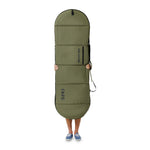
FARO Canvas Surfboard Bags provide the security, functionality, and durability you need for stress-free surf travel. Their superior construction protects your boards from damage, smart design helps you pack efficiently to avoid extra fees, and long-lasting quality means your investment pays dividends trip after trip. To learn more about the brand’s philosophy and commitment to quality, visit the FARO story page.
For Weekend Warriors and Short Trips: FARO Padded Day/Travel Surfboard Bag ($220) provides excellent protection for 1-2 boards with convenient storage pockets.
For Extended Trips and Multiple Boards: Browse the full FARO Travel Bags Collection to find the perfect fit for your quiver size and travel style.
For All Your Surfboard Storage Needs: Explore FARO Canvas Surfboard Bags for options ranging from single board day bags to heavy-duty travel bags.
Conclusion
Surfboard baggage fees in 2026 vary widely, but they don’t have to derail your trip. Choosing the right airline, understanding baggage classifications, and packing intentionally can save hundreds of dollars per journey.
Surf-friendly airlines like Alaska, Hawaiian, and select international carriers make travel easier, while others require careful planning to avoid penalties. Investing in a high-quality travel bag and preparing ahead of time is the best way to protect both your boards and your budget.
With the right knowledge, the right gear, and a clear understanding of airline rules and travel terms, flying with surfboards can be predictable, affordable, and stress-free.
Frequently Asked Questions